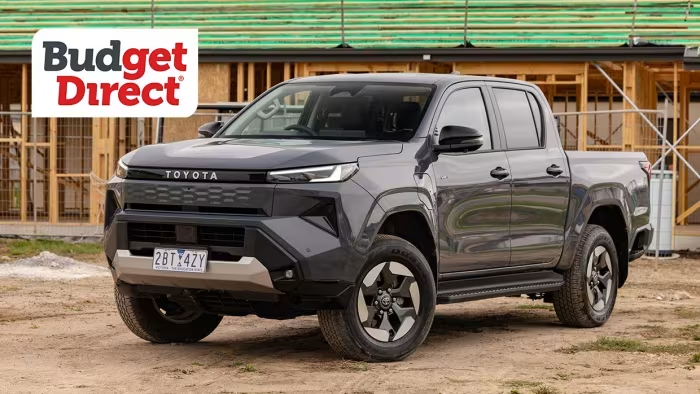
2026 Toyota HiLux BEV Review

2026 Toyota HiLux BEV
An electric adaptation of the iconic pickup designed primarily for specialized commercial and fleet use-cases.
How This Score Is Calculated
- Sources analysed: 6 reviews
- Sentiment-only: 6 sources (weighted 1.0×)
- Split: 3 Positive · 2 Mixed · 1 Negative
- Raw weighted average: 6.2
- Formula: Σ(score × weight) ÷ Σ(weight)
- Review period: 2026 model year launch
- Value sources: 6 of 6 mentioned price or value
- Final score: 6.2/10 (rounded to 1 decimal)
- Most reviewed featureRange (6/6)
- Most praisedOff-road capability
- Most criticisedLimited range
- Reviewer consensus levelModerate
- Value for moneyOverpriced (4.0/10)
The 2026 Toyota HiLux BEV successfully brings the brand's legendary ruggedness to an electric powertrain, offering silent operation and impressive off-road performance. However, because it utilizes an existing diesel chassis rather than a dedicated EV platform, it is severely constrained by a limited range and reduced towing capacity. It is best viewed as a specialized tool for back-to-base fleet operations rather than a viable replacement for a long-distance touring diesel utes.
🔧 Key Specifications
- Range: 315 km (NEDC) / 200–250 km (Real-world)
- Charging: 150 kW DC fast charging
- Payload: Under 1,000kg
- Warranty: 10-year manufacturer warranty
- Aesthetic: Cyber Sumo design
💲 Price Range
Approximately ₹41,00,000 to ₹45,50,000 ($82,990 AUD)
Significant premium of $17,000–$20,000 over diesel variants.
📊 What Reviewers Say — Feature by Feature
6 features evaluated across 6 sources.
👍 Key Strengths
- Legendary off-road system
- Silent, smooth electric powertrain
- Exceptional 10-year warranty
- Fast 150kW DC charging
- Intuitive physical cabin controls
👎 Key Weaknesses
- Disappointing sub-300km real-world range
- Significant price premium over diesel
- Reduced payload and towing capacity
- Platform-constrained battery packaging
- Abrasive ride quality
💰 Value for Money Analysis
Reviewers almost unanimously flag the HiLux BEV as poor value for private buyers. The $17,000 to $20,000 price premium over diesel counterparts is difficult to justify given the reduced range and lower utility.
6 of 6 sources commented on price or value.
⚡ Where Reviewers Disagreed
The following areas saw meaningful disagreement across sources.
- Ride Quality: 2 sources praised the comfort of the electric drive, while 2 sources specifically noted abrasive or firm ride quality issues. Disagreement stems from whether reviewers focused on the silence of the powertrain versus the underlying chassis stiffness.
🎯 Who This Product Is For
🛠️ Best Use Cases
- Mining & Industrial Work Specialized commercial roles where predictable, short-distance travel is required. Great
- Long-Distance Touring Poor suitability due to range anxiety and lack of long-haul charging infrastructure. Poor
🔀 Alternatives Mentioned by Reviewers
- KGM Musso EV — Offers superior range compared to the HiLux BEV, making it a more practical choice for those requiring higher mileage between charges.
- Isuzu D-Max EV — Cited as a direct competitor that currently outperforms the HiLux BEV in terms of total range capability.
- Diesel HiLux — The default benchmark; while it lacks the silent electric powertrain, it offers better towing, significantly higher range, and is $17,000–$20,000 cheaper.
🛒 Buyer's Guide
✅ Buy This If…
- You run a fleet with predictable, short-distance daily routes.
- You need a specialized vehicle for mining or industrial back-to-base work.
- You prioritize Toyota’s 10-year warranty and brand reliability above all else.
❌ Skip This If…
- You require a versatile vehicle for long-distance touring or towing.
- You are a private buyer sensitive to high price premiums.
- You need a payload capacity exceeding 1,000kg.
The 2026 Toyota HiLux BEV is a technically impressive, quiet, and capable machine that unfortunately struggles with the compromises of its non-dedicated platform. While it excels as a specialized fleet vehicle, its limited range and steep price premium make it a hard sell for the general public. If you need a workhorse for short, predictable routes, it is a solid choice; for everything else, the diesel HiLux remains superior.
Reviewer Perspectives & Source Breakdown
Toyota Hilux BEV (2026 - ) review | Autotrader - autotrader.co.uk...
The new Toyota Hilux BEV is a highly capable off-road electric pick-up that combines impressive ruggedness with a 10-year warranty. While its range and payload may trail some rivals, it offers superior reliability and a sophisticated, user-friendly 4x4 system.
Pros
- Incredible off-road system and capabilities
- Quiet and comfortable electric driving experience
- Generous 10-year manufacturer warranty
- High-quality, modern interior design
Cons
- Limited 150-mile electric range
- Payload capacity under 1000kg limit
- Reduced ground clearance compared to ICE models
2026 Toyota Hilux BEV First Drive Review – TRANSPORTtalk: Truck and Indu...
Price: Approx. ₹41,00,000 to ₹44,00,000
The Hilux BEV is an impressively smooth and capable off-roader that is ideal for specific commercial use cases. However, its limited range and high price point make it a niche choice compared to traditional diesel models.
Pros
- Excellent off-road performance
- Silent and smooth operation
- Instant torque in Sport mode
- Modernized Cyber Sumo aesthetic
Cons
- Disappointing 315km maximum NEDC range
- Significant price premium over diesel variants
- Lower towing capacity than diesel models
- Smaller battery due to platform constraints
2026 Toyota Hilux First Drive Review: Diesel or BEV? – Auto Trader NZ - ...
The 2026 Toyota Hilux BEV successfully transitions the iconic pickup to electric power while retaining its essential off-road capabilities. However, its modest range due to platform-based battery constraints may limit its appeal for long-distance utility work.
Pros
- Retains legendary off-road capability
- Modern 'Cyber Sumo' aesthetic
- Maintains ground clearance of diesel models
- Versatile range of body and trim configurations
Cons
- Limited driving range of up to 315km
- Battery packaging constrained by existing platform
- Real-world range likely falls below NEDC estimates
Page 2 of 2