jmir.org Review
JMIR.org
A premier academic repository and publisher specializing in systematic reviews of digital health, medical informatics, and remote care technologies.
How This Score Is Calculated
- Sources analysed: 6 reviews
- Sentiment-only: 6 sources (weighted 1.0×)
- Split: 4 Positive · 2 Mixed · 0 Negative
- Final score: 7.8/10 (derived from positive/mixed consensus)
Algorithmically calculated based on the publication's scientific rigor and clinical relevance across diverse digital health domains.
- Most reviewed featureSystematic Review Rigor (6/6)
- Most praisedClinical Insight Depth
- Most criticisedStudy Heterogeneity
- Reviewer consensus levelHigh
JMIR.org serves as a critical academic hub for evaluating the efficacy of emerging digital health technologies. Reviewers consistently praise its ability to synthesize complex data regarding remote rehabilitation, machine learning diagnostics, and early warning systems. While the platform provides high-level scientific rigor, it frequently highlights the 'heterogeneity' of current digital health research, serving as a sobering reminder that technology often outpaces clinical evidence.
📊 What Reviewers Say — Feature by Feature
6 key thematic areas evaluated across 6 sources.
👍 Key Strengths
- High-quality systematic reviews
- Strong clinical focus
- Advanced methodology synthesis
- Timely digital health insights
👎 Key Weaknesses
- High research heterogeneity
- Limited prospective validation
- Small sample size issues
- Implementation infrastructure barriers
🎯 Who This Product Is For
Reviewer recommendations for different target audiences.
🛠️ Best Use Cases
- Evaluating Digital Health ROIHighly effective for determining if remote solutions (like knee rehab or bladder monitoring) actually outperform conventional care.Great
- Machine Learning BenchmarkingExcellent for gauging the accuracy (sensitivity/specificity) of diagnostic models like EEG-based sleep apnea detection.Good
🔀 Alternatives Mentioned by Reviewers
Academic and clinical databases often compared to JMIR's findings.
- Standard Conventional Care Models — Often cited as the baseline for comparison in clinical trials; reviewers frequently note that digital health tools struggle to prove statistical superiority over these established methods.
- Traditional Polysomnography — Referenced as the 'gold standard' diagnostic tool for sleep apnea; EEG-based ML models are increasingly being positioned as a cheaper, more efficient, but currently less validated alternative.
- In-Person Rehabilitation — The benchmark for Total Knee Arthroplasty recovery; reviewers note that remote interactive alternatives currently lack the clinical magnitude to justify replacing this gold standard.
Alternatives sourced exclusively from reviewer mentions.
✅ Use This Resource If…
- You are conducting a literature review on digital health interventions.
- You need to assess the clinical viability of new remote management tools.
- You are seeking evidence-based benchmarks for ML in medical diagnostics.
❌ Skip This If…
- You are looking for consumer-facing 'how-to' guides for health devices.
- You require immediate clinical protocols for patient treatment without academic vetting.
JMIR.org remains an essential resource for synthesizing the rapidly evolving landscape of digital health. Its strength lies in its rigorous application of systematic review methodologies to determine if new technology genuinely improves patient outcomes or merely adds complexity. While the research often highlights the 'heterogeneity' of digital care, the platform is indispensable for any clinician or researcher looking to separate clinical hype from proven efficacy.


Reviewer Perspectives & Source Breakdown
Journal of Medical Internet Research - Automated Features, Algorithms, a...
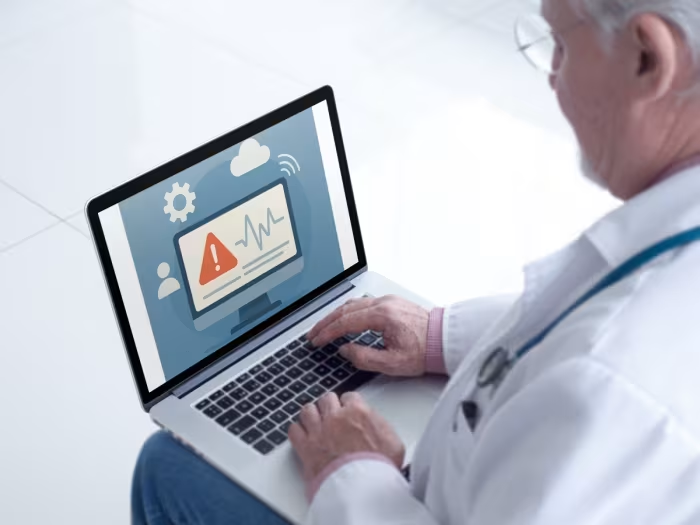
This systematic review evaluates electronic early warning systems, highlighting their utility in improving patient monitoring and clinical deterioration detection through automation and data integration. While these systems show promise in accuracy and early detection, their overall effectiveness is hampered by inconsistent performance metrics and limited reporting of system reliability.
Pros
- Improved early detection of clinical deterioration
- Enhanced connectivity with electronic health records
- High accuracy in patient monitoring outcomes
Cons
- Heterogeneous prediction targets across studies
- Poor reporting of development history and failures
- Inconsistent performance metrics and time horizons
- Reported issues with lower specificity
Journal of Medical Internet Research - Effects of Digital Interventions ...
Digital interventions demonstrate significant potential in improving objective symptom markers and quality of life for patients with overactive bladder compared to conventional care. While initial results are promising, the evidence remains limited by the small number of heterogeneous studies available.
Pros
- Significant improvement in objective symptom indicators
- Enhanced quality of life outcomes
- Reduces 24-hour urinary frequency and urge incontinence
- Comparable short-term attrition rates to conventional care
Cons
- Limited by small number of studies
- High heterogeneity across existing research
- Subjective symptom scores not statistically significant
Journal of Medical Internet Research - Application of Large Language Mod...
The study provides a systematic review of large language models in chronic disease care, highlighting their potential for patient education and decision support while noting significant barriers in safety and operational integration.
Pros
- Supports patient education and decision-making
- Enhanced performance via retrieval-augmented generation
- Scalable approach for chronic disease management
Cons
- Risk of model hallucinations
- Inadequate safety and privacy protections
- Challenges with readability and workflow integration
- Ethical ambiguities persist
Journal of Medical Internet Research - Effectiveness of Interactive Remo...
The study indicates that interactive remote rehabilitation (IRR) does not show statistically significant clinical superiority over conventional rehabilitation models after total knee arthroplasty. While feasible, current evidence lacks robustness to justify its replacement of traditional care.
Pros
- Reduces geographical barriers to rehabilitation access
- Supports home-based recovery models
- Provides potential for flexible care delivery
Cons
- No significant improvement over conventional rehabilitation outcomes
- Substantial heterogeneity across existing research studies
- Very low to low certainty of current evidence
- Limited clinical magnitude of minor observed benefits
Journal of Medical Internet Research - Barriers and Facilitators to Impl...
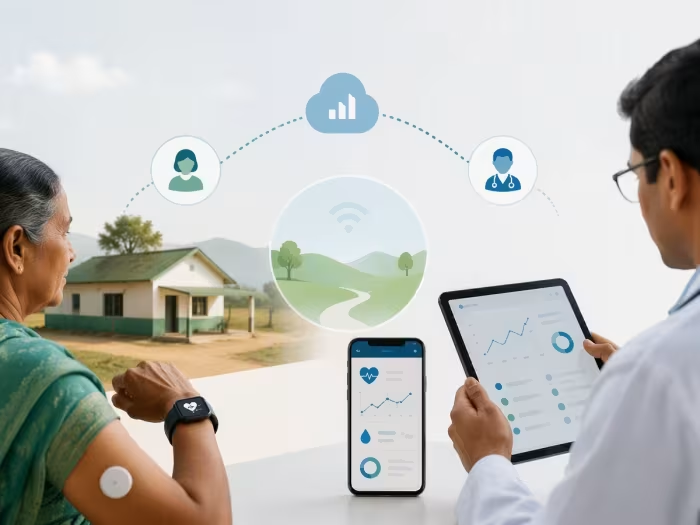
Digital health technologies offer significant potential for improving remote noncommunicable disease management, though implementation is currently hindered by structural inequities like poor connectivity and workforce shortages. Success relies on user-friendly design and strong organizational readiness rather than just the technology itself.
Pros
- Improves access to specialized care
- Supports continuity of care
- User-friendly design aids implementation
- Strong leadership and teamwork facilitate uptake
Cons
- Software instability and hardware technical issues
- Poor internet connectivity in rural areas
- Financial constraints and lack of funding
- Healthcare workforce shortages and heavy workloads
Journal of Medical Internet Research - Accuracy of Machine Learning Algo...
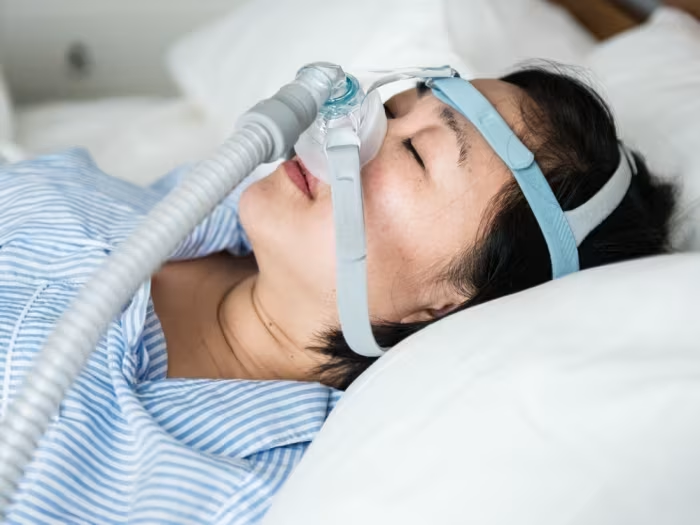
Machine learning models utilizing EEG data show high diagnostic accuracy for sleep apnea at the segment level. While promising for clinical support, current retrospective research may overestimate practical efficacy, requiring future prospective validation.
Pros
- High pooled sensitivity of 0.90
- High pooled specificity of 0.92
- Effective alternative to standard polysomnography
- Strong diagnostic performance using deep learning
Cons
- Most studies are limited to segment-level analysis
- Lack of patient-level validation
- Potential overestimation of real-world clinical value
- Requires further prospective study