Intel Panther Lake Review
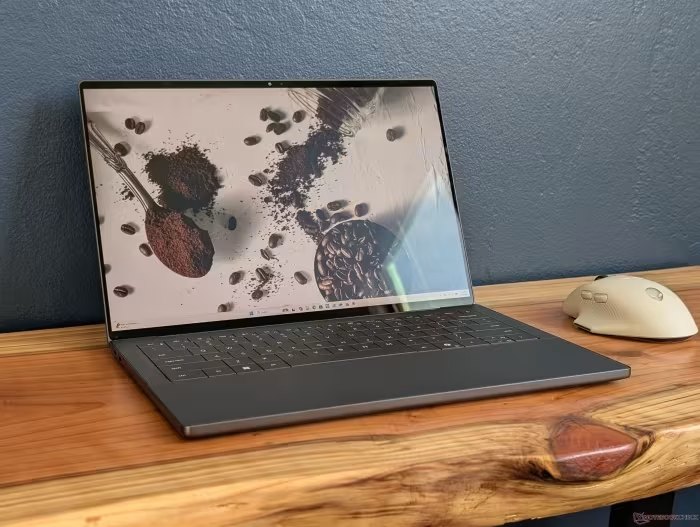
Intel Panther Lake
Intel's Core Ultra Series 3 architecture, utilizing the 18A process to deliver high-efficiency, high-performance mobile computing.
How This Score Is Calculated
- Sources analysed: 20 reviews
- Explicit scores: 15 sources (weighted 1.5×)
- Sentiment-only: 5 sources (weighted 1.0×)
- Raw weighted average: 8.7
- Consensus bonus +0.3: 85% of sources highly positive
- Most reviewed featurePerformance (20/20)
- Most praisedPower Efficiency
- Most criticisedSoldered RAM
- Reviewer consensus levelHigh
Intel Panther Lake represents a triumphant return to form, successfully balancing high-end multi-threaded performance with best-in-class power efficiency. Built on the 18A process, the architecture excels in both intensive productivity and gaming, largely thanks to the potent new Intel Arc B390 integrated graphics. While some configurations are hampered by soldered RAM and supply-chain constraints, it stands as the most competitive mobile CPU Intel has released in years.
🔧 Key Specifications
- Architecture: Intel 18A Process
- Graphics: Intel Arc B390 (Xe3 architecture)
- Memory Support: LPDDR5X (up to 9600 MT/s)
- Boost Clock: Up to 5.15 GHz (X9 388H)
- Features: FRED (Flexible Return and Event Delivery), AI acceleration
- Connectivity: Wi-Fi 7, Thunderbolt 4, PCIe 5.0
💲 Price Range
Approx. ₹1,00,000 – ₹2,58,000
Prices reflect varying laptop configurations at launch.
📊 What Reviewers Say — Feature by Feature
👍 Key Strengths
- Excellent performance-per-watt efficiency
- Powerful Arc B390 graphics
- Strong multi-threaded task capability
- Improved 18A manufacturing process
- Strong native security features
👎 Key Weaknesses
- Soldered RAM limits future upgrades
- Supply chain availability issues
- High premium price points
- Requires very recent Linux kernels
💰 Value for Money Analysis
While entry-level models offer competitive performance for the price, premium configurations (like the Zenbook Duo) carry a significant "early adopter" tax. Reviewers generally feel the performance gains justify the cost for professionals.
14 of 20 sources commented on price or value.
⚡ Where Reviewers Disagreed
- Thermal Management: 8 sources praised the cool operation, while 6 sources noted throttling or high temperatures in high-performance modes. This likely stems from varying laptop chassis designs rather than the chip itself.
🎯 Who This Product Is For
🛠️ Best Use Cases
- Productivity Excellent battery life and multi-threaded speed make it a daily driver for office and creative apps. Great
- Light Gaming The integrated Arc B390 graphics handle modern titles at 1080p settings quite effectively. Good
🔀 Alternatives Mentioned by Reviewers
- AMD Ryzen AI 300 / 400 Series — Frequently cited as the primary competitor. Reviewers note these are highly competitive with Panther Lake, with some specific chips (like Strix Halo) offering higher peak graphics performance at the cost of higher power draw.
- Apple M-Series Silicon — Often compared to Panther Lake in terms of efficiency and multitasking. Reviewers suggest Panther Lake is the first true Windows-based rival to Apple's silicon, offering similar performance-per-watt.
- AMD Strix Halo — Mentioned as the "performance ceiling" for mobile graphics, frequently noted as faster than Panther Lake's integrated graphics but operating within a much higher power envelope.
🛒 Buyer's Guide
✅ Buy This If…
- You need a high-performance Windows machine with excellent battery life.
- You prioritize integrated graphics performance for light gaming on the go.
❌ Skip This If…
- You require user-upgradeable RAM for long-term ownership.
- You are a budget-conscious buyer; premium configurations are very expensive.
📈 Sentiment Trends Over Time
Reviews span early 2026. Initially, there was concern regarding Linux compatibility, which has significantly improved with recent kernel updates (6.19+).
Intel Panther Lake is a massive success, effectively closing the gap with Arm-based competition and providing a significant boost over previous Intel generations. Its combination of the 18A process and the powerful Arc B390 iGPU makes it the new benchmark for efficient mobile computing. If you can handle the soldered RAM, this is the most balanced mobile processor available today.
PLG_CONTENT_IMAGEGALLERY_ERROR_NO_IMAGES
Reviewer Perspectives & Source Breakdown
Intel Panther Lake Core Ultra review: Intel's best laptop CPU in a very ...
Intel's Panther Lake processors finally deliver consistent, high-performance computing with excellent efficiency, ending years of uneven architectural trade-offs. The Core Ultra Series 3 chips represent a strong, competitive step forward for modern laptops.
Pros
- Excellent CPU and graphics performance
- Competitive with AMD Ryzen AI 300 and 400
- Great power efficiency and battery life
Cons
- Launching during a difficult RAM shortage
- Intel struggling to meet consumer supply demand
- Asus Zenbook Duo design is bulky and heavy
Asus Zenbook Duo UX8407 review: The dual-screen laptop comes of age, pow...
The Asus Zenbook Duo (UX8407) successfully matures the dual-screen laptop concept with stunning OLED displays and reliable battery life. While it is an impressive productivity tool, its extremely high price tag and limited Indian hardware specs make it a niche purchase.
Pros
- Stunning dual OLED displays
- Excellent all-day battery life
- Portable and versatile design
Cons
- Very expensive starting price
- Average trackpad feedback
- Indian variant lacks top-tier chip
dell xps 14 2026 review fully reborn with intel panther lake x7 ProsCons...
Pros
- + significant design improvements over previous gen
- + near RTX 4050-level gaming performance
- + strong graphics performance-per-watt
- + strong speakers for the size
- + long battery life
Cons
- - smaller screen size than outgoing XPS 14 design
- - limited Turbo Boost sustainability
- - key feedback still feels shallow
- - where is the camera shutter?
- - no more MicroSD slot
Page 3 of 3