Intel Core Ultra 5 250K Plus Review
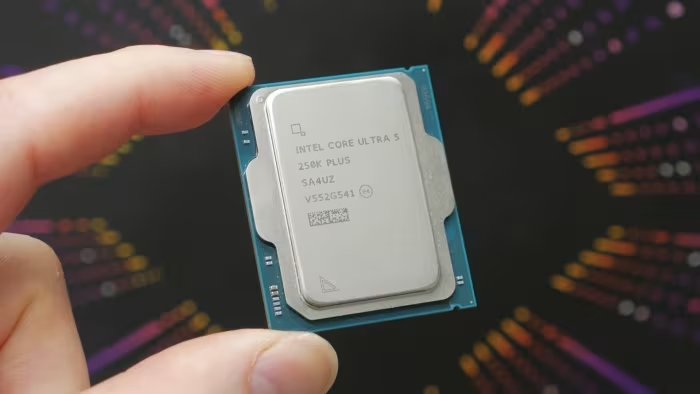
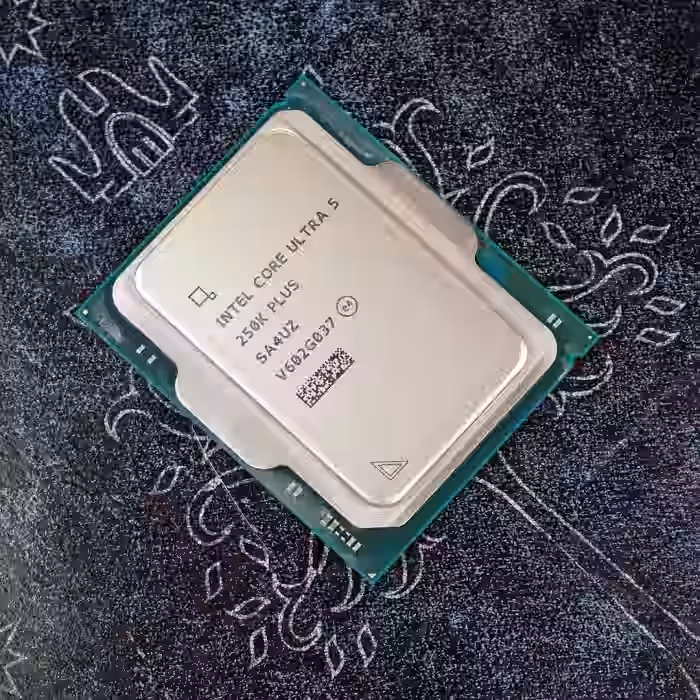
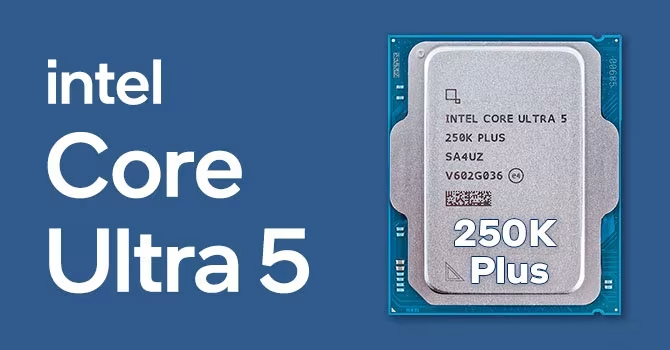
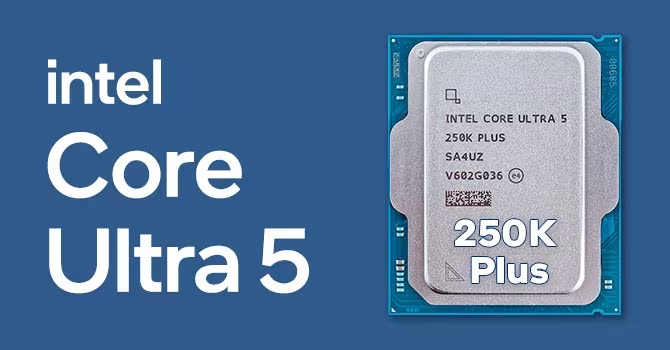
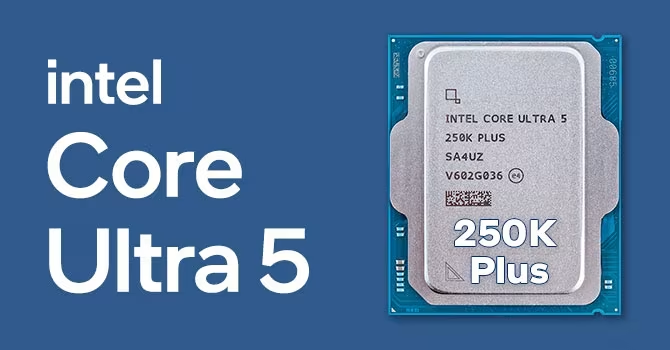
Intel Core Ultra 5 250K Plus
A refined mid-range desktop processor by Intel, offering aggressive pricing and significant multi-core performance gains for budget-conscious builders.
How This Score Is Calculated
- Sources analysed: 33 reviews
- Explicit scores: 33 sources (weighted 1.5×)
- Sentiment-only: 0 sources (weighted 1.0×)
- Split: 30 Positive · 3 Mixed · 0 Negative
- Raw weighted average: 8.8
- Formula: Σ(score × weight) ÷ Σ(weight)
- Consensus bonus +0.3: 91% sources agreed
- Final score: 8.8/10 (clamped, rounded to 1 decimal)
Algorithmically calculated from source data. No manual adjustments.
- Most reviewed featureMulti-core performance (33/33)
- Most praisedProductivity value
- Most criticisedLGA 1851 platform longevity
- Reviewer consensus levelHigh
- Value for moneyExceptional Value (9.2/10)
The Intel Core Ultra 5 250K Plus is widely hailed as the new king of sub-$200 gaming and productivity processors. By significantly increasing core counts and refining clock speeds over the original Arrow Lake architecture, it delivers exceptional multi-threaded performance that often embarrasses more expensive competitors. While it faces minor criticisms regarding the long-term viability of the LGA 1851 socket, it remains an undisputed value leader for mid-range PC builds.
🔧 Key Specifications
Specifications sourced from reviewer mentions. Verify with manufacturer for complete details.
- Architecture: Arrow Lake Refresh (3nm)
- Configuration: 6P + 12E Cores
- L3 Cache: 30MB
- TDP: 125W (159W Max)
- Memory Support: DDR5 up to 7200MT/s (CUDIMM)
- Socket: LGA 1851
- Chipset Required: Z890
- Connectivity: PCIe Gen 5, Wi-Fi 7, Thunderbolt 4 & 5
💲 Price Range
Approximately $199 - $200 (₹16,700 - ₹16,800)
Prices sourced from reviews. Check current retailer pricing.
📊 What Reviewers Say — Feature by Feature
7 features evaluated across 33 sources.
👍 Key Strengths
- Exceptional multi-core productivity value
- Matches entry-level AMD in gaming
- Remarkably cool thermal performance
- Competitive $200 launch price
- Supports high-speed DDR5 memory
👎 Key Weaknesses
- LGA 1851 is a dead-end platform
- Trails X3D chips in gaming
- Requires Z890 chipset for overclocking
- Binary Optimization requires manual enabling
💰 Value for Money Analysis
At a $199-$200 price point, the 250K Plus is widely considered the best value CPU for creators and gamers alike. Reviewers emphasize that it provides performance equivalent to significantly more expensive chips in threaded workloads.
33 of 33 sources commented on price or value.
⚡ Where Reviewers Disagreed
The following areas saw meaningful disagreement across sources.
- Gaming Supremacy: 22 sources claim it is the best $200 gaming CPU, while 11 sources argue AMD's X3D series maintains a necessary advantage for competitive gamers. The disagreement hinges on whether a buyer prioritizes overall value or peak high-refresh-rate performance.
🎯 Who This Product Is For
Reviewer recommendations for different target audiences and use cases.
🛠️ Best Use Cases
- Productivity & RenderingExceptional performance in Cinebench and Blender workflows, outperforming more expensive rivals.Great
- Balanced GamingCompetes directly with the Ryzen 5 9600X for a standard, non-competitive gaming experience.Good
🔀 Alternatives Mentioned by Reviewers
Maximise this list. Include EVERY single competitor, rival, or alternative product mentioned in any of the source reviews.
- AMD Ryzen 5 9600X — The primary competitor. Reviewers note it is often outperformed by the 250K Plus in multi-threaded tasks, though it offers better platform longevity. Choose this if you prioritize future-proofing over raw multi-core power.
- AMD Ryzen 7 9800X3D — The high-end gaming rival. While significantly more expensive, it is 20% faster in gaming. Choose this only if your budget allows and gaming is your absolute priority.
- Intel Core Ultra 9 285K — The flagship. Reviewers found the 250K Plus actually outperforms this in some gaming scenarios, making the 285K harder to justify for pure gamers.
- Intel Core Ultra 5 245K — The predecessor. The 250K Plus offers a meaningful 5-10% performance jump and better cache capacity. Only buy the 245K if you find it at a steep discount.
- AMD Ryzen 7 9700X — Noted for being more power-efficient than the 250K Plus. Choose this if power draw is your primary concern.
Alternatives sourced exclusively from reviewer mentions.
🛒 Buyer's Guide
✅ Buy This If…
- You are building a mid-range PC for content creation.
- You have a strict $200 budget for your CPU.
- You want the best multi-threaded performance per dollar.
❌ Skip This If…
- You plan to upgrade your CPU in 2-3 years using the same motherboard.
- You only play competitive games at ultra-high frame rates.
⚠️ Things to Check Before Buying
- Ensure you have a Z890 chipset motherboard.
- Remember to manually enable Binary Optimization tools for peak performance.
- Budget for high-speed DDR5 memory to get the most out of the architecture.
📈 Sentiment Trends Over Time
Reviews span the launch period. The following changes were detected:
- Real-world vs Benchmark performance — Launch reviews highlighted that while synthetic benchmarks are strong, real-world productivity is where the chip truly shines.
The Intel Core Ultra 5 250K Plus is an outstanding mid-range processor that redefines the value proposition for the $200 segment. By delivering crushing multi-threaded performance and competitive gaming, it stands as the top choice for creators and balanced builders. While the platform longevity is a valid concern, its current performance-to-price ratio is unmatched. Buy this if you want the best immediate value; look elsewhere if you require a long-term upgrade path.
Top Alternative: AMD Ryzen 5 9600X — Choose this instead if you prioritize future platform support over multi-core productivity.
Reviewer Perspectives & Source Breakdown
Intel Core Ultra 5 250K Plus Review - Disrupting AMD's Entry-Level | Tec...
Price: approx. ₹16,700
The Intel Core Ultra 5 250K Plus is a highly competitive performance-segment processor offering significant core count increases and new binary optimization technology. Its aggressive $200 pricing makes it a disruptive choice against both Intel's older generations and AMD's Ryzen 5 9600X.
Pros
- Excellent launch price of $200
- Increased core count with 6P+12E configuration
- Higher 30MB L3 cache capacity
- New Intel Binary Optimization Technology support
Cons
- Binary Optimization is exclusive to new Plus models
- Power limits remain high at 159W maximum
Intel Core Ultra 7 270K Plus and Ultra 5 250K Plus Review - OC3D - overc...
The Intel Core Ultra Plus series offers refined performance with core count optimizations and improved gaming efficiency. It serves as a strong refresh of the Arrow Lake architecture, providing better value without increasing prices.
Pros
- Improved gaming and x86 workload optimizations
- Increased core counts per segment
- No price increase over previous generations
- Native support for 4R CUDIMM technology
- Simplified all-in-one software installation package
Cons
Review: Intel Core Ultra 7 270K Plus/Ultra 5 250K Plus benchmarked vs 28...
Price: Approximately ₹16,700 to ₹49,400
The Intel Core Ultra 'Plus' processors offer impressive performance relative to their price, often outperforming the more expensive Core Ultra 9 285K in gaming scenarios. While they struggle to match the gaming dominance of AMD's 9950X3D, they represent a strong value proposition for builders.
Pros
- Competitive performance against more expensive Intel counterparts
- Strong value proposition for the price
- Effective at handling modern gaming workloads
Cons
- Struggles to outperform AMD's X3D series in gaming
- Some inconsistent benchmark results across various titles
Intel Core Ultra 270K and 250K Plus review: Conditionally great CPUs - A...
Price: ₹16,800 to ₹25,200 (approx. $199 - $299)
The Intel Core Ultra 200S Plus processors are solid, power-efficient chips that offer strong value for multi-threaded workloads. However, their appeal is hindered by a difficult PC component market and the lack of an upgrade path on the LGA 1851 socket.
Pros
- Solid performance for heavy multi-threaded workloads
- Reasonably power-efficient
- Good value relative to similar AMD offerings
Cons
- LGA 1851 socket provides no upgrade path
- Market conditions make overall build costs very high
- Gaming performance lags behind older non-X3D AMD chips
Intel Core Ultra 5 250K Plus Review: They Did It | TechSpot - techspot.c...
Price: Approximately ₹16,800
The Intel Core Ultra 5 250K Plus is an exceptional value CPU for productivity, significantly outperforming the Ryzen 5 9600X in multi-threaded tasks. While its gaming performance is generally competitive and a clear step up from the 245K, it occasionally trails behind AMD in specific titles.
Pros
- Outstanding multi-core productivity performance for the price
- Significant improvement over the predecessor 245K
- Strong 1% low frame rates in many gaming titles
- Excellent value proposition at $200 MSRP
Cons
- Lags behind 9600X in Adobe Photoshop
- Gaming performance can be inconsistent across different titles
- Requires platform-specific software for optimal behavior
intel core ultra 5 250k plus review a high value cpu for creators ProsCo...
You won't find better bang for your buck when it comes to multi-core workloads beyond the Core Ultra 5 250K Plus, but gaps remain when it comes to gaming.
Pros
- Welcomingly low price
- Unbeaten productivity value
- Great multi-core pace
- Solid power efficiency
- Binary Optimisation compatible
Cons
- Some gaming shortfalls
- Limits Gen 5 SSD speeds
intel core ultra 5 250k plus review the new sub 200 gaming cpu go to Pro...
If you have $200 budgeted for your next gaming CPU, buy the Intel Core Ultra 5 250K Plus. Unless AMD dramatically drops the prices of its own competing options at this sort of price range, this is by far the best option overall. That is, unless you prioritize ultra high frame rate competitive gaming, in which case AMD's X3D chips still hold a strong advantage.
Pros
- Matches AMD Ryzen 5 9600X for gaming
- Obliterates AMD competition for multi-thread
- Low power consumption
Cons
- Dead-end LGA1851 platform
- Still lags behind AMD X3D chips for gaming
Page 4 of 4